








News
Using Minoru with the Carl Zeiss Cinemizer Plus
Carl Zeiss have just published a guide to using Minoru to create 3D content for their Cinemizer Plus.

The new video eyewear from Carl Zeiss is your take along personal video screen and mobile TV. In the future, you'll be able to watch any movie anywhere.
The special ZEISS technology guarantees unparalleled image quality on an imaginary TV screen with a 115cm (45 inches) diagonal at a distance of 2 meters (78 inches) for the cinemizer video glasses.
Link - Minoru 3D Videos for the Carl Zeiss cinemizer plus
Link in German - Minoru 3D Videos for the Carl Zeiss cinemizer plus
'Heroes of She' 3D Music Video
Upcoming band 'Heroes of She' have used a Minoru 3D Webcam to record what they believe to be the first 3D band video on YouTube. Have a look and listen using the player above. I'm sure you will agree that it's a great use for Minoru.
Heroes of She's Hammond organ player, James Mackie:
“Making the video was timely, especially with all the publicity surrounding the upcoming release of James Cameron’s 3D blockbuster ‘Avatar’. People are saying that Hollywood studio executives are now considering mothballing their conventional productions to chase after the illusion of depth you get with 3D.”
The 3D format also chimes with the Lancaster-based band’s retro, pre-Space Age, Hammer House of Horror image. The previous ‘golden age’ of 3D cinema, in the 1950s, saw the release of films such as House of Wax, starring Vincent Price, Inferno and Robot Monster.
Singer Helen Longworth, who with Amy Worth, is one of the band’s two vocalists, said:
“We wanted to capture the massive energy of our live performances. The illusion that 3D creates of us coming straight out of the screen is a great way to do this. Amy and I were really singing during the filming as well - often in music videos the true energy of a vocal performance is ignored in favour of looking airbrushed and posed. We treated the shoot as if it was a live gig.”
www.heroesofshe.com , www.myspace.com/heroesofshe
Minoru and OpenCV
Researchers at the Nagoya Institute of Technology have been carrying out some work in the field of computer vision using Minoru and OpenCV.
http://nma.web.nitech.ac.jp/fukushima/minoru/minoru3D-e.html
OpenCV is a computer vision library originally developed by Intel. It is free for commercial and research use under a BSD license. The library is cross-platform, and runs on Windows, Mac OS X, Linux, PSP, VCRT (Real-Time OS on Smart camera) and other embedded devices. It focuses mainly on real-time image processing, as such, if it finds Intel's Integrated Performance Primitives on the system, it will use these commercial optimized routines to accelerate itself.
Released under the terms of the BSD license, OpenCV is open source software.
Minoru enters the World of Robotics
Minoru has found his way into the World of Robotics.
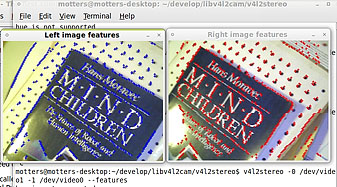
Some software has recently been written which can be used to turn the Minoru
webcam into an inexpensive ranging sensor. This could be used on any robot
with an onboard PC of one kind or another (such as a netbook), and should
perform well ...
http://forums.trossenrobotics.com/showthread.php?t=3358
http://code.google.com/p/sentience/wiki/MinoruWebcam
The Minoru is the first commercially available stereo webcam. It's primarily intended for entertainment - broadcasting stereo anaglyphs as a novel alternative to the usual webcam based video conferencing or blogging. However, it also makes a good inexpensive range sensor for robotics use.
LINUX Supported
Hi everybody,
I've just realized that my latest announcement to the linux-uvc-devel mailing list is awfully old. I had to do something about it, and I'm pleased to announce that the Linux UVC driver now supports the Minoru3D stereo camera.
The Minoru3D (http://www.minoru3d.com) is a cute, anthropomorphic device made of two UVC cameras mounted in a single case and spaced roughly the same distance apart as human eyes to get a stereoscopic effect.
The latest Linux UVC driver supports streaming from both cameras simultaneously at 30fps (up to 320x240) or 15fps (up to 640x480). You can download it from the Linux UVC Mercurial repository
(http://linuxtv.org/hg/~pinchartl/uvcvideo) or wait for Linux 2.6.30.
Please note that anaglyph (pseudo-3D image with red and blue or red and cyan components), "picture in picture" and "side by side" output provided by the Minoru3D driver on the Windows platform is not supported at this stage. This is an excellent opportunity for all of you to get into V4L2 application development and write a nice anaglyph Linux application :-)
I would like to thank Promotion & Display Technology for helping the Linux UVC driver development by providing both hardware samples and technical information.
Cheers,
Laurent Pinchart
We would like to thank Laurent for all his hard work in making this possible.
More Articles...
Page 1 of 2


Your Basket is empty.

